



About SRE Certification
Overview
Site Reliability Engineering Training and Certification

Benefits of SRE Certification
For Individuals
- Learn how to get started in enhancing system reliability and resilience.
- Gain deep insights into the principles, practices and benefits of Site Reliability Engineering (SRE).
- Practice and master tools used in SRE to design and implement a reliable and resilient system.
- Effectively implement SRE practices within your organization to elevate performance.
- Understand what to measure, monitor and how to create meaningful reliability objectives.
For Organizations
- Having trained staff applying SRE practices will mean fewer outages, faster recovery times, and more resilient systems that maintain service availability.
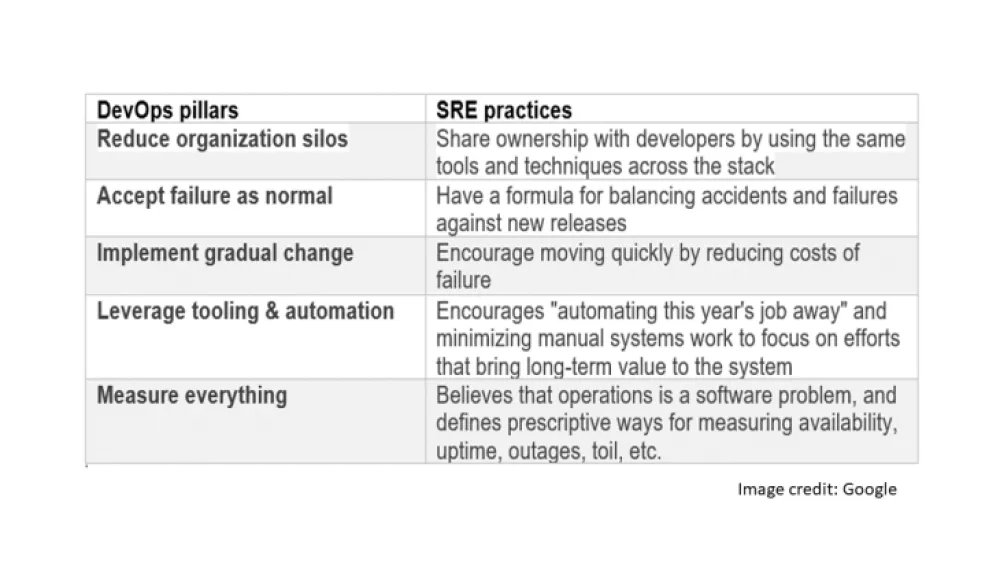
- SRE will break down silos between development and operations, supporting a stronger DevOps culture.
- Teams are equipped with best practices in observability, root cause analysis, and proactive monitoring resulting in faster incident response.
- Increased customer trust and satisfaction through delivery of reliable systems and greater uptime.
- Offering SRE training shows commitment to technical excellence and career development, which will help to retain staff.
Useful links
Useful links
-
SRE Fundamentals training
Success in 1 2 3
Over 2.6 million people in 192 countries have an APMG certification. Our certifications are used by 80% of the FTSE 100 and a third of the Fortune 500 and S&P 500, and are proven to deliver better outcomes.
Select your certification
APMG certifications can advance your career, build your confidence and help you transition into a new field. Browse our careers section for inspiration or visit our certification pages for details of what you’ll learn and how you will benefit from certification.
Choose your learning style
APMG is not a training provider. Please contact accredited training organization's listed on our website for prices and dates. Alternatively, you can self-study for an exam directly through APMG.
Pass the exam & receive a certificate
When you are ready to take your exam, book an online timeslot yourself with APMG, or your training organization may organize this for you. If you pass your exam APMG will issue you with a digital badge for you to share!
SRE Certification levels

Videos
Videos
Site Reliability Engineering (SRE) - A mediator between two worlds
What is SRE Site Reliability Engineering - How developers look at operations - Midday Mentors
SFIA

This APMG certification has been informally mapped against the SFIA Framework to indicate the skills that are addressed and referenced by the certification. Although it is not yet possible to claim this digital badge, the indicative skills can be used to plan your professional development through assessing the skills you have and the skills you need for the role you want.
 knowledge
Fundamentals
Generic attribute Knowledge up to level 3
Same as above plus IT infrastructure up to level 4, Systems and Software Life Cycle Engineering level 4
Related products



FAQs
Some certifications do not require training in order to take the exam however, for most certifications, training is advised.
For some certifications individuals also have the option to self-study in preparation for the exam and, when they are ready, can even take the exam from the comfort of their home or office.
You can find details of our self-study exams, available to purchase, via our public exams portal.
Unfortunately, no. Only Accredited Training Organizations and their registered partners are authorized to use these logos. If you do not fall under these categories and would like to request permission to use the logo, please contact the APMG-International Service Desk (servicedesk@apmg-international.com).
However, successful candidates are able to share and display their digital badge publicly.
Please contact us via email addressed to customerservice@apmgroup.co.uk. Please review our policies before submitting your written feedback.
PMI Professional Development Units (PDUs) are either: Education or Giving Back to the Profession. You can earn PMI Education PDUs by attending non-PMI provider courses if they align with the PMI Talent Triangle® skill areas. Visit the PMI website for details on PDUs, how to record them and required documentation.
- Most training providers include the exams with their courses.
- Self-study candidates can book and take the exam online from anywhere, with a proctor monitoring via webcam, microphone and desktop.
- After booking, you'll receive a registration email to schedule your session through the Candidate Portal, with exams available 24/7.
- APMG also offers limited public exam sessions at designated regional offices.
- The structure of the examinations depends on the level of certification.
- Generally, entry-level examinations (Foundation Certifications) have a range of 40 minutes to 60 minutes to complete a multiple-choice exam, which may include 40 to 60 questions.
- Practitioner examinations can range from 90 minutes to 120 minutes with an average of 80 complex multiple-choice questions.
- The required score to pass an examination varies from one certification to another. You can find more information listed on the product page under exam details, to learn more about a particular examination.
If you booked your exam directly with us, you will have 12 months to sit your exam which cannot be extended. If your exam was booked by a Training Organization, then you will need to reach out to them directly to request an extension to your expiry date.
Full details of our Equality Policy can be found on our website.
Any request for additional time will need to be provided in writing to customerservice@apmgroup.co.uk. We will need to see evidence of your diagnosed condition in the form of a medical report, signed by a medical practitioner.
If this is not available, or your condition was diagnosed a long time ago, then any statement from an employer, line manager or Occupation Health advisor will be sufficient.
If no recommendations regarding the length of time to be added to the exam is evident in the documents supplied, then we apply 25% additional time to the exam.
Please contact our 24/7 Technical Team on +44 (0)1494 452450 and select Option 3 for Technical Assistance or email them at help@apmg-international.com. They are also available via a live chat.
If this is a password creation issue, please note that '?', '@', '#', and 'é' are not allowed for creating a portal password.