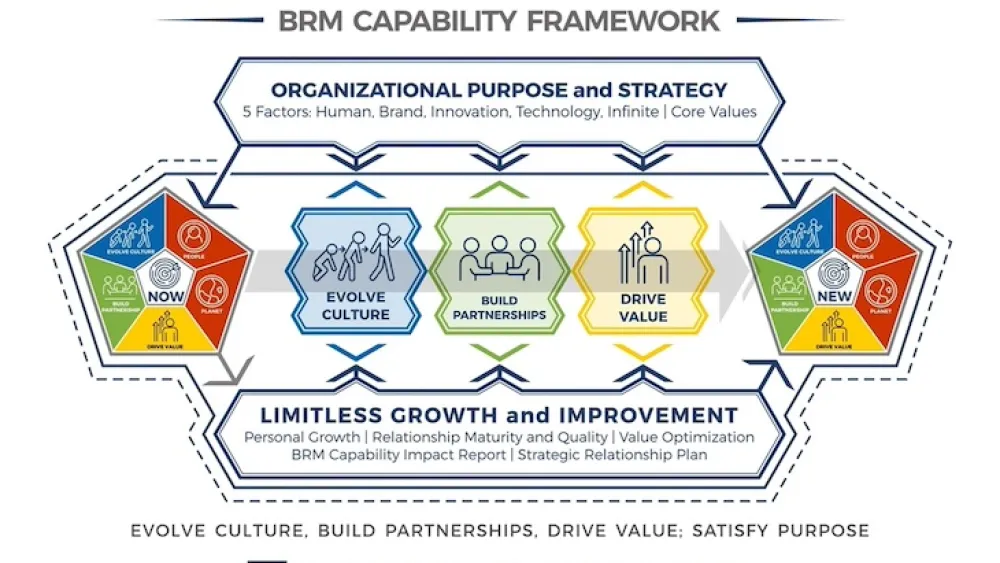
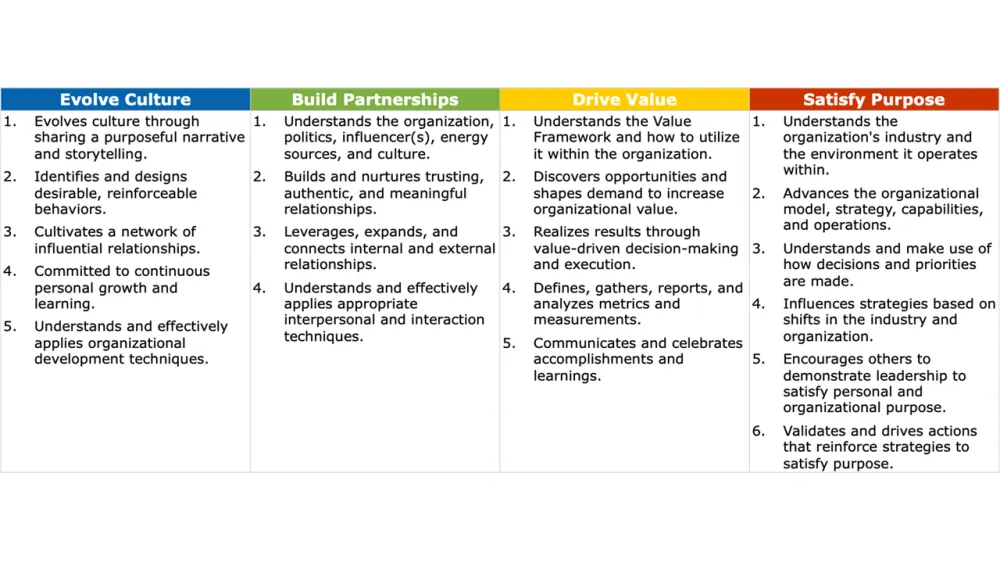
The table of BRM Competencies was created by the Business Relationship Management Institute. Copyright © 2021 Business Relationship Management Institute, Inc. All Rights Reserved.
Exceptional leaders can easily spot these competencies within their team members as well as those within their larger relationship network. They can identify those who have the ‘right stuff’ and differentiate them as the individuals who can be entrusted with critical initiatives that will make or break careers and ensure those pivotal projects don't end up as flaming disasters on their desk. But here’s the dilemma, those leaders can’t coach everyone all at the same time. They need a reliable methodology, an approach to systematically identify strengths and weaknesses in competencies – and not just areas that could be improved, but areas that demand improvement.
The BRM Competency Model evaluates proficiency across four discernable levels which are:
- Awareness (Explorer): where individuals recognise there is a new behavioural model that is being adopted.
- Comprehension (Beginner): the level where individuals gain an understanding of how they must behave differently within the organisation’s new practices.
- Application (Practitioner): individuals are able to create new ways of doing things and optimise those practices.
- Influence (Master): the highest level, individuals demonstrate the ability to shape the culture of the larger organisation, driving results directly aligned with the strategic direction.
In addition to these levels, the model includes knowledge, skills and mindset as exhibited behaviours to each proficiency level.
- Knowledge: is the element that focuses on facts and concepts relating to a particular competency.
- Skills: considers an individual’s expertise or aptitude for a given competency.
- Mindset: is the element that heavily considers the human condition by acknowledging an individual’s feelings and/or motivations behind each competency.
While a traditional organisation leaves relationship-building to chance, a relationship-centered organisation treats work relationships with the same level of respect as every other core capability within the organisation. This tool provides consistency for measuring relationship capabilities, but more importantly, the competency model helps with identifying areas for individual improvement; the stronger the competency, the stronger the capability, and thus the stronger and more resilient the organisation.